How to Kill the Curiosity of a Child
Oct 21, 2026
So, we have all asked questions, right? From our parents, teachers, strangers, elders, and siblings.
Most of the time, we hear a no, get a straightforward answer, or hear something like, “That’s just how it is.” But sometimes, an answer isn’t enough. We get the answer to our question, but we still wonder why. So we ask again. And again.
And since our parents are busy, our teachers have a syllabus to finish, and nobody has the time to entertain every little question, we eventually hear: “Stop asking so many questions.”
And that’s how it begins. When curiosity is repeatedly dismissed, a child might eventually stop asking questions altogether. Not because they’ve found all the answers, but because asking no longer feels worth it. And I think that’s one of the easiest ways to kill a child’s curiosity.
We’re all chasing rewards
This isn’t just about children. It’s about how humans fundamentally behave. In a way, we are a little like machines. We have objectives, we take actions, and the consequences influence what we do next. When an action rewards us, we’re more likely to repeat it. When it punishes us, we’re more likely to avoid it.
Think about social media. You watch a reel, find it interesting, and get a little reward out of it. So you watch another. And another. The same mechanism influences how we learn skills, develop habits, seek validation, and do the things we enjoy.
Our experiences influence what we repeat, what we avoid, and what we eventually become good at.
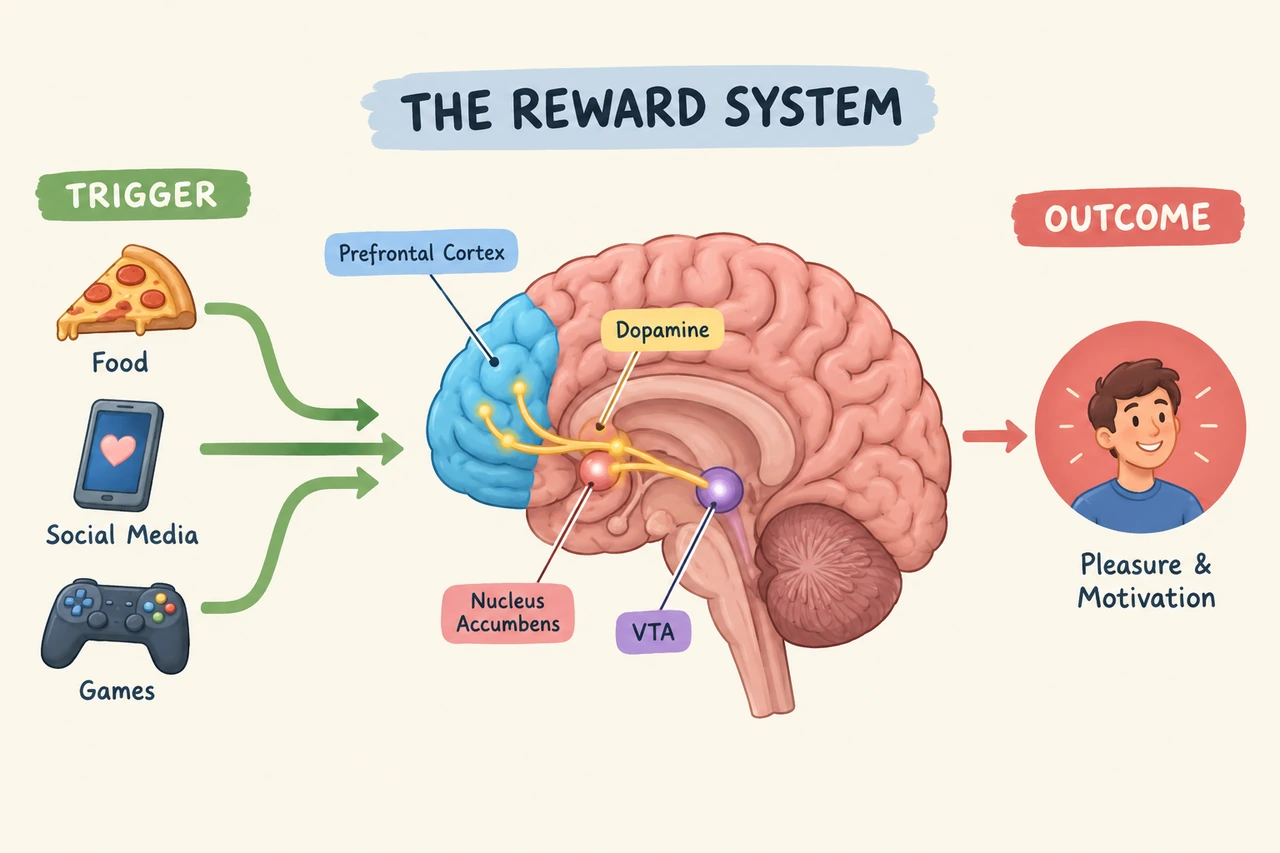
And if we understand this mechanism, we can use it to become the person we want to be. We’ll explore that in another blog. But for now, let’s bring it back to children.
So, what’s the solution?
And even more importantly, who am I to answer this question?
I’m not a psychologist, philosopher, or doctor. I’m just a former child who asked questions, wondered why things worked the way they did, and eventually started questioning why I did things the way I did.
So here’s my answer:
Don’t always give children the answer. Sometimes, let them figure it out themselves.
Imagine little Johnny asks his father:
“Dad, why can’t little toy trains carry real people?”
His father could simply say, “Because it’s too small and can’t carry that much weight.” That’s a perfectly reasonable answer.
But what if his father instead says, “Interesting. What do you think would happen if we tried adding some weight to it?”
Obviously, we aren’t going to let a child sit on a fragile toy train. But we can experiment with weights and see what happens. Johnny might discover that the train struggles to move. He might wonder whether a stronger motor could solve the problem, or whether the train itself needs to be built differently.
And now, something interesting has happened. Johnny didn’t just learn that a toy train can’t carry a person. He started figuring out why.
Teach them how to think
Look at the difference. In the first case, Johnny receives information. In the second, he discovers something for himself. He starts identifying problems, investigating their causes, and thinking about possible solutions.
And the best part? He can apply this way of thinking to other things. When something breaks, he can investigate why. When he encounters a difficult problem, he can experiment instead of immediately giving up. One question can lead to another, and another, until a simple toy train becomes an engineering problem.
Of course, one experiment won’t turn a child into an engineer. But imagine giving them thousands of such opportunities throughout their childhood.
Curiosity gives them questions. Experimentation helps them find answers.
And perhaps that’s how we give them a better chance of doing exceptional things. But there’s an important distinction here. Not every question needs an experiment. Sometimes, a simple explanation is enough. You just need to know when to give an answer and when to let them find one.
What happens when they fail?
So far, we’ve talked about a child who experiments and reaches a conclusion. But what if they fail? What if Johnny tries something, gets it wrong, and is punished for it?
He might try harder next time. Or he might learn to avoid trying altogether. Think about it. If getting something wrong consistently leads to punishment, why would a child willingly put themselves in a position where they could fail?
They might become very good at avoiding failure without becoming very good at learning. And avoiding failure is one way to guarantee that you won’t fail at anything new. It’s also a way to guarantee that you won’t discover much.
So what should we do instead?
When a child fails, we shouldn’t automatically stop encouraging them. We can help them understand what went wrong, acknowledge their effort, and encourage them to try again. The reward for failure shouldn’t be greater than the reward for success. But failure shouldn’t mean losing all encouragement, either. We want them to keep trying, learn from their mistakes, and eventually succeed.
Teach them to fear stagnation more than failure.
Can we use this elsewhere?
I think this idea extends beyond children. Consider how we learn skills, develop habits, and change our behaviour. If our experiences consistently discourage us from doing something, we may eventually stop doing it. If they encourage us, we may continue.
This is one reason I find the connection between human behaviour and machine learning interesting. In reinforcement learning, an agent interacts with an environment, receives rewards or penalties, and adjusts its behaviour. The reward function influences what it learns to do.
Humans are obviously more complicated than machines. Still, the analogy gives us an interesting way to think about behaviour. What if, instead of asking only how to change someone’s behaviour, we asked what is rewarding their current behaviour in the first place?
Could we use this understanding to develop better habits, improve education, or help people change? Could we use similar ideas to improve AI systems and make them produce more reliable answers instead of convincing-looking nonsense?
I think these are questions worth exploring. Exceptions always exist, and not every problem can be solved this way. But that doesn’t make the underlying idea any less interesting.
Conclusion
We don’t need to be experts to influence how a child experiences learning. We just need to be a little more conscious of how we respond when they ask questions. Instead of immediately giving them the answer, sometimes help them find it. Instead of punishing every mistake, help them understand it. And instead of treating curiosity as an inconvenience, give it room to grow.
You never know what a child might become when they’re encouraged to explore the things they find interesting. And perhaps we should apply the same principle to ourselves. The next time you encounter something you don’t understand, don’t just look for the shortest answer and move on. Ask why. Experiment. See where the question takes you.
And if a child ever asks you a question you don’t know the answer to, there’s nothing wrong with saying:
“I don’t know. Let’s find out.”
“The greatest discoveries often begin with a simple question that nobody bothered to answer.”
Note: AI was only used for image generation